Quick answer: read five pages a day, attached to something that already happens, and count pages rather than minutes. Five is deliberately low — it is the number you can still finish on a bad Tuesday, which is the only reason the habit survives to month two.
Nearly every failed reading habit starts the same way: thirty minutes a day, an hour at weekends, a list of fourteen books. It works for nine days.
Five pages is a worse goal in every way except the one that matters. It is small enough that skipping it requires an actual decision rather than a busy evening.
Why pages beat minutes
A thirty-minute target measures the wrong thing. You can spend it rereading the same paragraph while thinking about work, and the tracker still records a win. You can also read for eleven good minutes and record nothing.
Pages are honest about output, and they are easier to start. “Read for half an hour” asks you to commit a block of the evening; “read five pages” asks you to open the book. Those are different-sized requests, and the second one gets said yes to far more often.
There is a second effect that only shows up later. Pages accumulate into something you can look at — 140 pages in a fortnight — where minutes evaporate. Progress you can see is progress you argue with less.
Attach it to something that already happens
“Read every day” specifies the action and leaves out the hard part, which is when. Pick a moment that occurs whether or not you are motivated: the coffee brewing, the train pulling out, the phone going on charge for the night.
The best cue for reading is usually the one immediately before a habit you would rather do less of. Five pages before opening social media at night works because the alternative is right there, and the book wins only if it is closer than the phone.
Remove the steps between the cue and page one
This matters more than the target. Every decision between the cue and the first page is a chance to do something else instead.
Keep the book where the cue happens, not on a shelf in another room. Leave the bookmark exactly where you stopped, so the session begins with reading rather than searching. Choose the next book before you finish the current one, because the three-day gap while you decide is where reading habits quietly die.
Set the target in the app as a real number
A checkbox tells you the habit happened. A counted target tells you what happened, and for reading that difference is worth having.
In the habit form, the goal section takes a value and a unit — pages is one of 19 available, alongside minutes, kilometres and litres. Set five and leave the rhythm daily.
Log the pages before you put the book down
Recording the session from memory at bedtime produces round numbers and quiet exaggeration. Logging it while the book is still open takes two seconds and gives you a record you can trust a month later, which is the only reason the numbers are worth keeping at all.
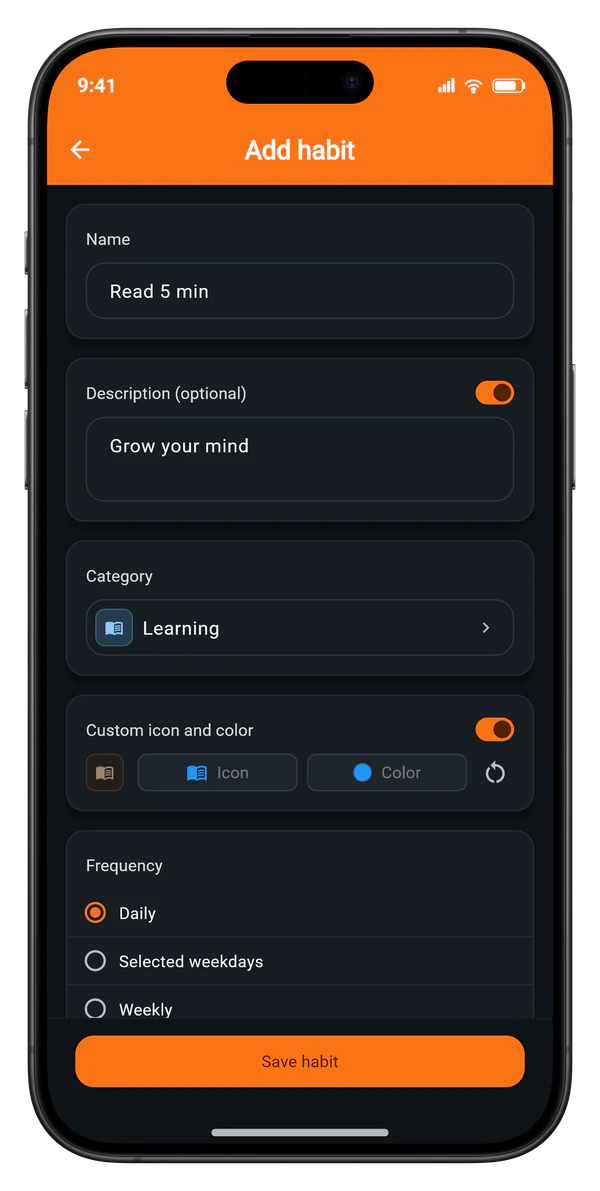
Resist the urge to raise the number because you read twenty pages last Sunday. The baseline exists for your worst day, not your best one. Counting also gives you something sturdier to review than a streak, which is the argument in tracking habits without obsessing over streaks.
The minimum and the extra are not the same thing
Keep one official target: five pages. Anything beyond that is optional, and — this is the part people get wrong — it must stay optional even on the days you do it.
The moment a good Sunday becomes the new standard, an ordinary Wednesday starts registering as failure. Five pages is the success condition. Finishing the chapter is a bonus that changes nothing about what counts tomorrow.
When you miss a day
Return to five pages. Not ten, not a weekend catch-up session.
Then spend thirty seconds on the cause, because a missed day is usually mechanical rather than moral. The book was in the other room. The cue moved. The material was too heavy for 23:00 — which is a real thing, and the answer is a lighter book at night, not more discipline.
Fix one of those and complete the ordinary target. If the gap already ran into a full week, the comeback plan for a habit you dropped is a better starting point than rebuilding the routine from nothing.
What two weeks tells you
After a fortnight, open the habit’s statistics. Three things are worth looking at: how many days you read, how many pages in total, and what time of day the reading actually happened.
That third one surprises people. Priya set her reading habit for 22:00 with a five-page target. After two weeks the time-of-day breakdown showed most of her completions between 07:10 and 07:40 — on the train, not in bed. She moved the reminder to the morning and the pages per week went from 41 to 68, with the same target and no extra willpower.
Raise the number to ten only if five has become automatic and the larger target fits the schedule you actually have. Otherwise keep five and read past it whenever you feel like it. The best reading target is not the biggest one you can finish once. It is the one you keep returning to.