Quick answer: set the habit to a weekly rhythm with a target of three, rather than ticking Monday, Wednesday and Friday. The week becomes the unit that counts, so a session that moves from Tuesday to Thursday is not a miss — it is the same week, rearranged.
Some habits genuinely belong to specific days. A Tuesday class is a Tuesday class. But plenty of habits only need to happen often enough, and pinning those to weekdays creates a problem the habit never had.
Training three times a week is the obvious example. So is language practice, deep work, cleaning, and calling your parents.
The difference fixed days make
A Monday-Wednesday-Friday gym plan looks tidy on paper. The trouble starts when Wednesday is swallowed by a late meeting, because now the week reads as a failure with two out of three, even though you could easily train on Thursday and finish the week exactly where you intended.
A weekly target moves the goalposts to where the goal actually is. Three sessions, seven days, your choice of days. You keep the accountability — three is still three — and you lose the part of the system that punished you for owning a calendar.
The argument against flexibility is that fixed days remove a decision, and that is true. If your week is genuinely predictable, fixed days will serve you better. Most weeks are not that predictable, and people keep choosing the rigid version anyway because it feels more serious.
Setting it up
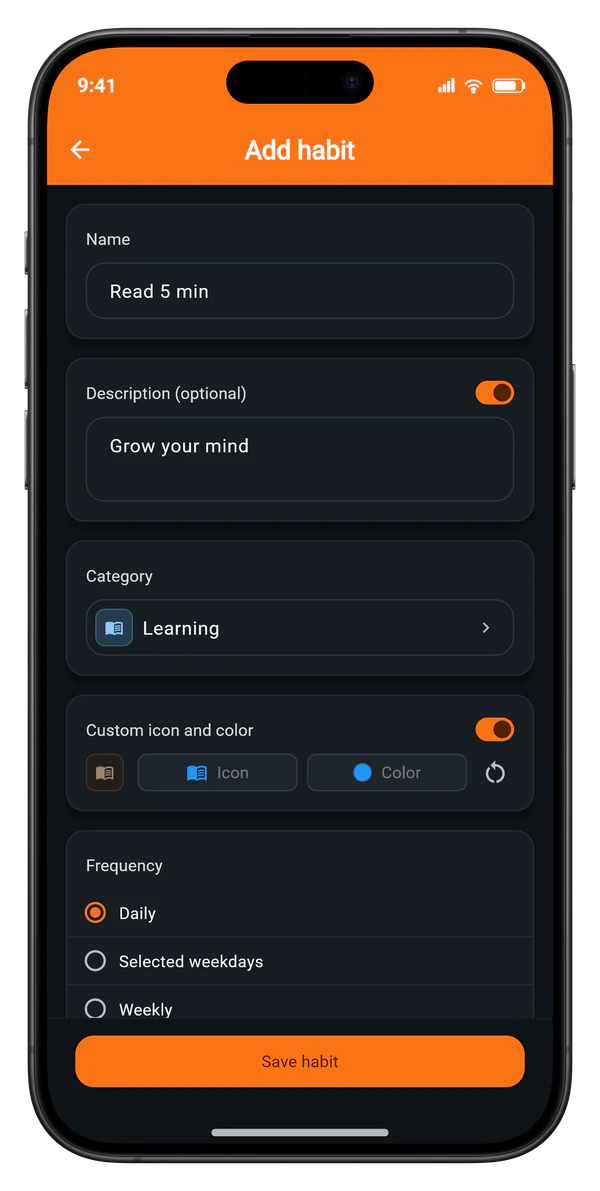
Habit Tracker offers five rhythms in the habit form, in the row marked Repeat: daily, selected weekdays, every X days, weekly and monthly. Weekly is the one you want here, and it costs nothing — daily, selected weekdays and weekly are all in the free plan. Every X days and monthly sit behind Premium, because they are built for longer cycles.
Name the habit after the action rather than the schedule. “Gym sessions” survives a change of plan; “Monday gym” does not. Then set the target — three — and let the week count the rest.
Reminders for a habit with no fixed day
A daily reminder makes no sense for a weekly habit — five of those seven alerts are asking about a day you never planned to use.
Weekly habits get checkpoint reminders instead: a small number of nudges spread across the period, arriving while there is still time to act. The free plan uses a fixed pair, on Thursday and Sunday, which turns out to be a sensible shape. Thursday asks whether the week is on track while two days remain; Sunday is the last honest chance. Premium lets you set anything from one to five checkpoints if that rhythm does not suit you.
What counts as a session
Decide this before the first week, because a vague definition gets generous by Sunday afternoon. Twenty minutes in the gym counts. Five minutes of stretching at home does not, unless you said it did in advance.
For habits where quantity matters more than occurrence, use a value instead of a checkbox — Habit Tracker counts in 19 units, so “three sessions” can just as easily be “90 minutes this week” if that is the truer measure.
A week that actually happened
Maya sets the gym to three sessions a week. She trains on Monday. Tuesday and Wednesday disappear into a deadline. On Thursday the checkpoint reminder arrives: one of three, three days left.
She trains Thursday evening and again on Saturday morning. The week closes at three out of three. Under a Monday-Wednesday-Friday plan, the same effort — the same three sessions — would have been recorded as one on time, two late, one missed day, and the following Monday would have started with the feeling of being behind.
Nothing changed except the unit of measurement. That is most of what a flexible schedule does: it stops the tracker from lying about a week that went fine.
When fixed days really are better
Before you decide, check whether one particular day is doing the damage: the weekday breakdown in the habit’s stats shows a completion rate for each of the seven days, and a single sinking day argues for a flexible target rather than a louder reminder.
Use selected weekdays when the habit is welded to something in the calendar — a class, a therapy session, a shift, preparing for a meeting that always falls on Thursday. In those cases the day is not a preference, it is part of the habit, and a flexible target would let you drift away from the thing you are actually trying to attend.
Everything else usually belongs on a weekly target. For a worked example that counts time rather than sessions, see how to track study habits with a changing schedule.
Judge the week, not the day
The useful question stops being “did I do it today” and becomes “am I still on track this week”. Two sessions on Wednesday is comfortable. One session on Saturday is not, and the checkpoint told you so on Thursday.
The weekly view in habit statistics is where that gets settled, and it keeps attention on consistency rather than an unbroken run — which is the whole argument in tracking habits without obsessing over streaks. If an entire week does vanish, do not redesign the schedule in frustration; the plan for restarting a habit is shorter and works better.