Quick answer: do not restart the whole routine. Choose one habit, shrink the next step until it is almost too small, complete it today, and rebuild from there. The missed week needs no repayment.
A missed week feels heavier than it is. Seven days is nothing next to the months the habit is meant to last, and the damage is rarely the gap itself.
The damage happens in the days after, when a normal break quietly becomes a full stop because starting again now requires a whole new plan, a Monday, and a better version of you.
Keep the habit and its history
The first instinct is usually to delete the habit and create it again with a clean record. Resist it. You are erasing the evidence that the habit worked for six weeks before it stopped, which is the single most useful thing you own right now.
A pause is a state, not a failure
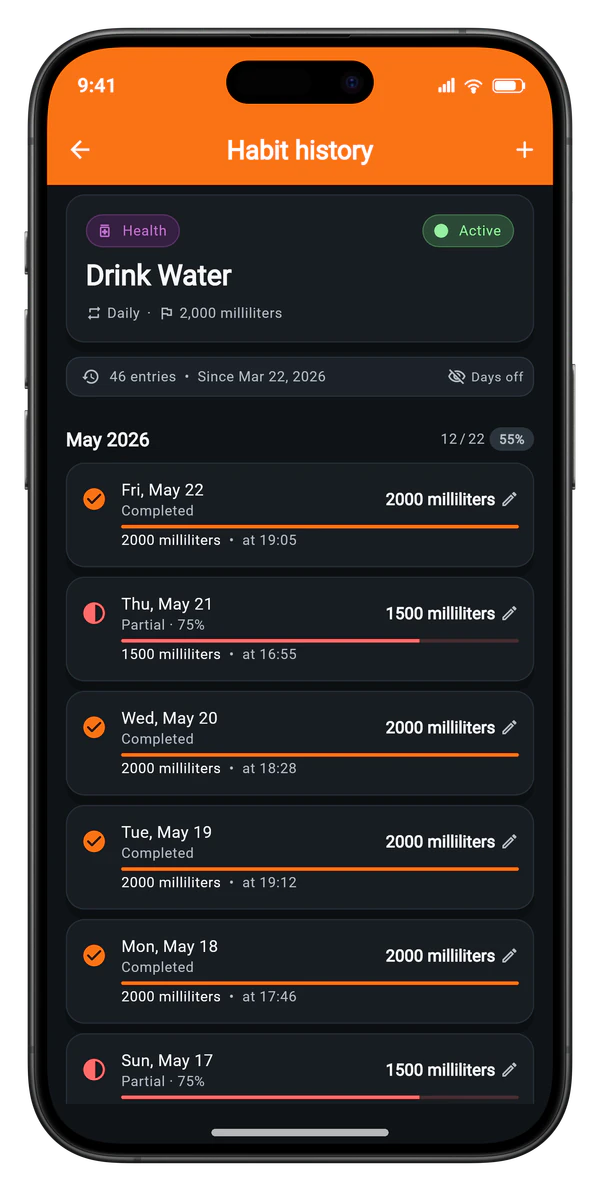
Habit Tracker is built around that assumption: a habit you pause keeps its history, the pause carries a date and an optional reason, and the details screen shows the current streak next to the length of the break. You can even set a date for it to resume itself. None of that exists to make you feel better — it exists because a paused habit with context is easy to restart, and a deleted habit is a decision you have to make from scratch.
Shrink the next action until it is almost embarrassing
Whatever the habit was, the version you return to should be smaller. A workout becomes ten minutes. Reading becomes two pages. Studying becomes fifteen minutes with the phone in another room.
This is not motivational softness. After a break, the thing you have lost is not fitness or vocabulary — it is the automatic quality of starting, and you rebuild that by starting, not by performing. Ten honest minutes today beats a perfect session you schedule for Saturday and skip.
One habit, not the whole routine
If the week you missed contained four habits, the temptation is to relaunch all four on Monday. That relaunch usually survives two days.
Pick one. The best candidate is the habit that makes the others easier, or simply the shortest one. Once a single habit is running again, the routine has a pulse, and the rest is easier to add than to resurrect all at once.
A tile on the home screen helps more than it sounds during a comeback, because the habit is visible without opening anything and one tap logs it — see home screen widgets for the four free tiles and how they differ.
Do not pay the week back
Here is where most restarts die. Seven missed workouts become a plan for five this week. A missed reading month becomes a fifty-page daily target. A skipped study week becomes a weekend sprint.
Compensation plans fail for a boring reason: they are harder than the schedule that already defeated you when you were fresher. You are not behind. There is no debt. There is a habit that did not happen for a while and can happen today.
The useful reset is unglamorous. One small completion today. The normal target tomorrow. A review after three days, not three weeks.
Ask what actually broke
Once the first completion is logged — and only then, because the question is unanswerable while you feel guilty — ask what made the habit hard last week.
The honest answer is usually mundane. The reminder arrived while you were driving. The habit needed forty minutes and your week had twenty. The schedule demanded Monday, Wednesday and Friday, and your Wednesday moved. There were nine active habits and your attention paid for it.
Change one thing, not the system
Then change one thing. One. If the timing was wrong, move the reminder — Habit Tracker’s smart time suggestions, a Premium option, will offer a better slot once a habit has been logged at least five times, but your own guess is usually fine. If the schedule was the problem, a weekly target of three sessions removes the fixed days entirely. And if the reminder had simply become noise among many, setting reminders without notification fatigue deals with that properly.
A three-day comeback
Day one: the smallest version of one habit, at a time you are actually free.
Day two: the same habit, the same time. Repetition at a fixed moment is what rebuilds the automatic part; variety comes later.
Day three: keep going, and add a second habit only if the first one happened on both previous days. If it did not, day three is another attempt at day one, which is a normal outcome and not a reason to redesign anything.
That is the whole plan. Momentum comes from a clean restart, not from punishment. If what still bothers you is the broken number rather than the missed days, it is worth reading why a streak is one signal rather than the definition of success.