Quick answer: start with three habits — drink a glass of water, move for five minutes, and decide the first task of the day. Attach them to something that already happens, such as the kettle boiling, and keep the whole routine under ten minutes until it runs without effort.
Most beginner morning routines collapse in week two. Not because the habits were wrong, but because the plan assumed a morning that never arrives: awake at six, nobody else in the kitchen, a clear head, forty minutes to spare.
A routine that survives an ordinary Tuesday looks much smaller than the ones people post about. Three habits. Ten minutes. No perfect start time.
Why three, and not eight
Here is the unpopular part: how many habits you start with matters more than which ones you pick. Eight good habits fail together, because a routine is a chain and the chain breaks at the first link you skip. Three ordinary habits that actually happen beat a brilliant eight-step morning you abandon before the end of the month.
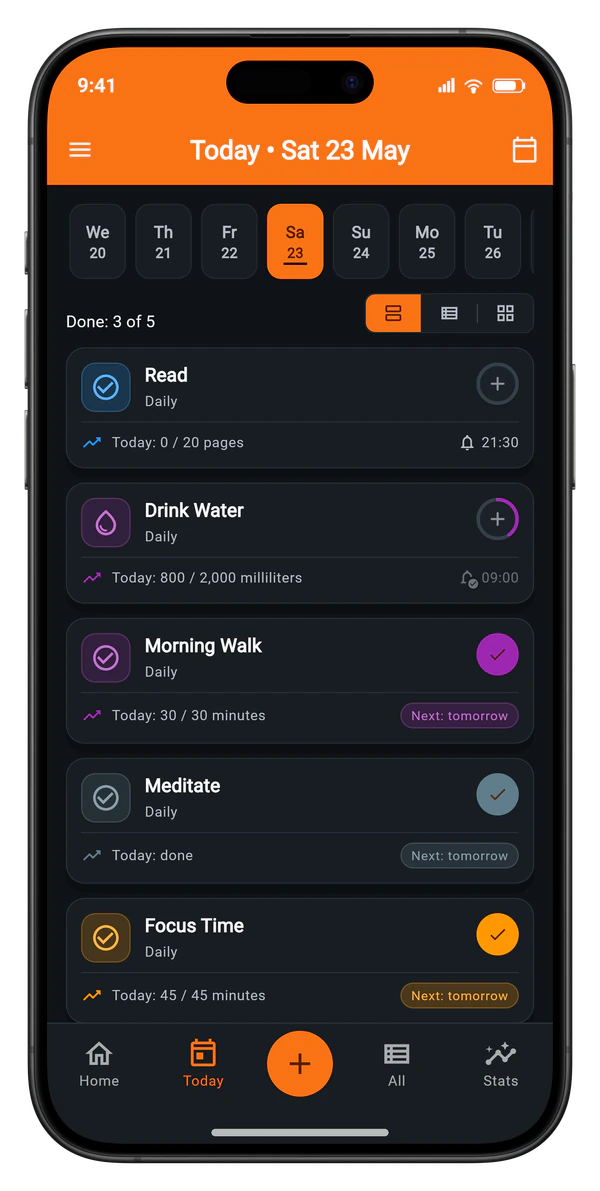
Three also fits the screen. The Today section of the dashboard shows three habits before it collapses into an “All 5” link, and a home screen tile stays readable at three rows. That is not a coincidence. A routine you take in at a glance is a routine you finish.
The three habits worth starting with
Water, with a number on it
Water works as a first habit because it takes fifteen seconds, needs no motivation and is easy to measure. A vague “drink more water” gives you nothing to tick off at eleven in the morning.
Give it a value instead: 250 ml, or one glass before coffee. Habit Tracker counts quantitative habits in 19 units, so litres, millilitres and glasses are real targets rather than a note you write beside a checkbox. The daily view then reads 800 / 2,000 millilitres, which nudges differently from an empty circle.
Five minutes of movement
Not a workout. Five minutes of stretching, a walk to the end of the street, or two minutes of mobility while the coffee brews. In the first fortnight the job is to make starting boring, not to get fit.
If five minutes feels insulting, set the target at five minutes anyway and do more on the days you feel like it. The target is a floor, not a ceiling, and a floor you clear on a bad morning is the only reason the habit reaches month two.
One decision about the day
The third habit is the one people skip, and it is the one that changes the day: pick the first real task before the phone picks it for you. Write one line. Not a plan — one line. “Finish the invoice.” “Call the clinic.”
What the first week actually looks like
Alex sets up three habits on a Sunday evening: 250 ml of water, five minutes of stretching, one task written down. The reminder goes at 07:10, when the kettle goes on.
Monday and Tuesday run perfectly. Wednesday he oversleeps, drinks the water in the car park and skips the rest. Thursday and Friday hold. Saturday the whole thing disappears. Sunday he manages two of the three.
That is five days out of seven for water, four for stretching, four for the task. On a chart it looks unimpressive. In practice it is a successful first week, because nothing was abandoned and nothing needed rebuilding. The mistake beginners make is reading Wednesday as failure and quitting on Thursday.
So set the bar where it belongs. In week one, success means completing at least one habit every morning and all three on at least three days.
Keep the routine where you can see it
A routine you have to open an app to remember is competing with every notification that arrived overnight. Putting the three habits on a home screen widget makes the list the first thing on the screen, and the tile carries a check button, so the water gets logged without unlocking the phone properly.
One reminder helps too. Only one. Three alerts at 07:00, 07:05 and 07:10 train you to swipe notifications away, which is precisely the habit you do not want to build.
When the routine stops fitting
After a fortnight, one of three things is true. The routine is automatic, in which case add a fourth habit — one, not three. It happens but still takes effort, so change nothing for another week. Or one habit keeps failing while the others hold.
That last case is information, not weakness. Usually the habit is attached to the wrong moment, or it does not belong in the morning at all. Movement often survives better as a weekly target of three sessions than as a daily obligation you resent by Thursday.
When mornings are stable, the same three-habit shape works at the other end of the day. A simple evening routine is usually what makes the morning one easier, because half of a good morning is decided the night before.
Start tomorrow with the water. The other two can wait until that one is boring.