Quick answer: pick three small evening habits — reset one surface, prepare one thing you need tomorrow, and write down tomorrow’s first task. Attach them to an event such as putting your plate away, give each one a finish line you can name, and keep the whole routine inside ten minutes.
An evening routine turns into an unfinished project the moment it includes tidying the house, planning the week and catching up on everything the day swallowed. Ten minutes of preparation is not a smaller version of that. It is a different job.
The job is to remove two or three predictable obstacles from tomorrow morning, on an evening that may well include a late dinner and no enthusiasm whatsoever.
Pick a cue before you pick a time
A fixed time works when your evenings look alike. Most people’s do not, and 21:00 on a Monday has nothing in common with 21:00 on a Friday.
An event is sturdier. Put the plate in the dishwasher, close the laptop, drop the keys in the bowl — each of those already happens, and each leaves a natural gap afterwards. Make the plan specific enough to picture: after putting away my plate, I clear the kitchen table.
If you often eat out, choose a cue that survives those evenings too, such as coming through the front door. Try it for a week before deciding the cue is wrong; the first three evenings always feel artificial, whatever you choose.
The three habits
Reset one surface
One surface. Not the room, not the flat. Your desk, the kitchen table, or the shelf where the keys land.
Define what finished means before you start, because “tidy” has no endpoint at 22:30. Finished might be: enough clear space for the laptop and a notebook. Or: my usual breakfast spot is usable. Give it two minutes, stop when the area works, and drop the paperwork you did not deal with into a tray instead of starting a filing session.
If the reset regularly overruns, the area is too big. Shrink it. “Clear my place at the table” survives a bad evening in a way that “tidy the kitchen” never will.
Prepare one essential
Think about what you hunt for in the morning, and prepare that one thing. The work bag, tomorrow’s clothes, the notebook beside the laptop, the bottle by the door.
Be equally strict about the finish line. “Pack my bag with keys, wallet and notebook” ends. “Get ready for tomorrow” expands for as long as you let it. Three minutes is usually enough, and where something has to charge overnight, leave the charger where you will see it while packing.
Write tomorrow’s first task
One line, in whatever you will actually look at in the morning. The point is to replace an intention with a visible first move: “study” becomes “answer the first three practice questions”, “work on the proposal” becomes “draft the opening paragraph”.
Two minutes, then close the notebook. You are not planning the day, you are removing the first decision from it. If you already follow a simple morning routine, this note feeds its third habit — no reason to make the same decision twice.
Track the three separately, not as one routine
It is tempting to create a single habit called “evening routine” and tick it when the evening went well. Do not. A single tick tells you nothing on the evenings you do two things out of three, and those evenings are the majority.
Three daily checkbox habits — reset the desk, pack the bag, write the first task — give you three separate lines of evidence. After two weeks the pattern is usually obvious: the bag gets packed every night, the desk gets cleared twice a week. Now you know which habit to shrink, and you did not have to guess.
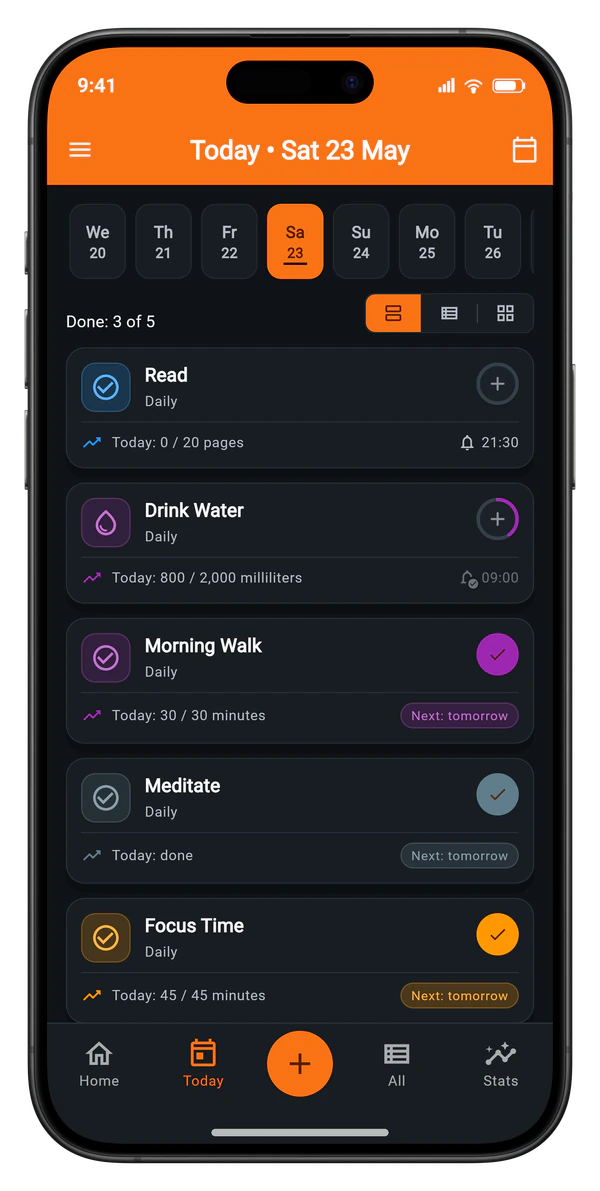
Give late evenings a smaller finish line
Decide now what the short version is, while you are not tired. Clear only the laptop space, put the keys in the bag, write one line. Agree that this counts as done, and it will still be done at 23:40 when the full version is not happening.
Miss an evening completely and the answer is the ordinary routine tomorrow. No double reset, no planning two days to make up for it. If the gap stretched into a week, the comeback plan for a habit you dropped is a better guide than willpower.
Keeping the three habits on a home screen widget helps at exactly the moment they are most likely to be skipped — the phone is already in your hand, and the tile is between you and whatever you were about to scroll.
Review after seven evenings
Two questions per habit: did it happen, and did it make the morning easier? Both matter, and the second one is the one people forget to ask.
A habit that helped but rarely happened needs a smaller scope, a different cue, or one well-timed reminder attached to the event rather than the clock. A habit that happened every evening and changed nothing should be replaced by preparation for a problem you actually have.
Tonight: one surface, one essential, one line. Put the plate away, do those three, and stop. The rest of the evening is yours.