Quick answer: open the habit, go to its stats and read the By day of week card. It gives a completion percentage for each of the seven days. If one day sits fifteen points or more below the rest across at least four weeks, you have found a scheduling problem, and scheduling problems do not respond to willpower.
Most people describe a wobbling habit as a motivation problem. Look at four weeks of logs and it is usually something far more boring: the same day failing over and over, while the other six are fine.
That is good news. A day you can name is a day you can change.
Where the weekday breakdown lives
Open any habit, tap through to its statistics and scroll past the heatmap and the trend. By day of week is a card of seven rows — Monday to Sunday, each with a bar and a percentage. Every per-habit statistic in Habit Tracker is free, including this one, so there is no paywall between you and the answer — the full picture is on the habit statistics page.
There is a second weekday chart in the global stats tab, and I would ignore it for this job. On the free plan the global view is limited to the current week, which gives you exactly one sample per day, and one Tuesday tells you nothing about Tuesdays. The per-habit card reads your whole logged history. Use that.
How many weeks before the numbers mean anything
Four weeks is the floor, and six is better. The arithmetic is unforgiving: with four weeks of data, each weekday has four samples, so a single miss moves that day by 25 percentage points. Two habits can look identical in a fortnight and tell opposite stories by week six.
So treat small gaps as noise. A spread of five or ten points between your best and worst day is how normal weeks look. It is the day that keeps sinking while the others hold steady that deserves attention.
What a real dip looks like
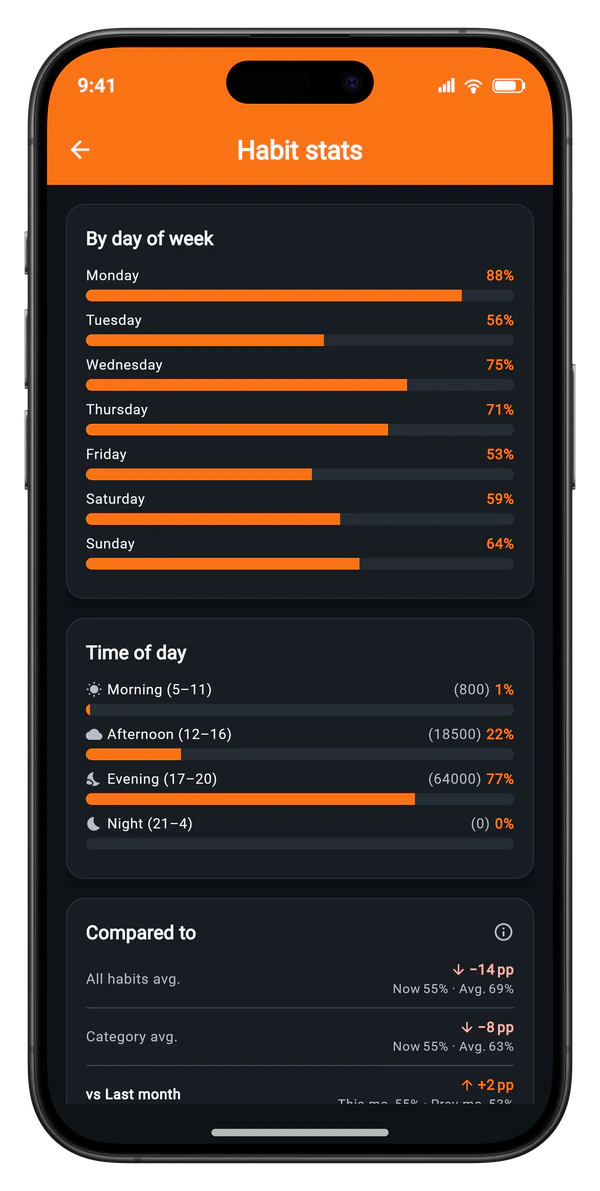
Read the card above as a real week. Monday comes in at 88 per cent, Wednesday at 75, Thursday at 71, Sunday at 64, Saturday at 59, Tuesday at 56 and Friday at 53. Monday to Friday is a 35-point drop, and that is not variance, that is a habit designed around Monday energy and run on Friday exhaustion.
Notice that Tuesday is nearly as weak as Friday, and far more likely to be missed by the person living it. Fridays feel like a failure. Tuesdays just quietly happen and do not get logged.
A worked example: Ola and the Friday gym session
Ola trains three times a week and logs it as a daily habit ticked on the days she goes. After five weeks her weekday card reads: Monday 80 per cent, Wednesday 80, Friday 40. The first two are healthy. Friday has one completion in five.
Her instinct was to set a louder reminder. What the chart actually said was that Friday finishes at 18:30 with a 40-minute commute, and no reminder makes a 20:00 arrival at the gym appealing. She moved the third session to Saturday morning and it ran at 100 per cent for the next month.
Same person, same motivation, same habit. One different day.
What the Time of day card adds
Directly under the weekday breakdown sits Time of day, which sorts your completions into four bands:
- Morning, 5–11
- Afternoon, 12–16
- Evening, 17–20
- Night, 21–4
This is where the cause usually shows up. If a habit with an 08:00 reminder logs 77 per cent of its completions in the evening band, the reminder is not prompting anything — you are doing the habit hours later, for your own reasons, and the morning alert is just a notification you have trained yourself to dismiss. Move the reminder to where the behaviour already is, which is the whole idea behind setting reminders that do not become noise.
The two cards work together. The weekday card says which day breaks. The time-of-day card says when the day breaks, and that pair is usually enough to name the cause without any guesswork.
Fix the day, not yourself
Once you can name the day, the repairs come in order of cost. Start cheap. Picking the expensive one first is what keeps people redesigning the same routine for months.
Move the cue or shrink that day’s version
Start with the smallest change. If the habit is attached to something that does not exist on the failing day — an office desk, a school run, a lunch break — attach it to something that does. Failing that, lower the bar for that day only: a fifteen-minute walk instead of a run, three pages instead of ten. The target value in the habit form stays editable even after you have logged days, so dropping from 30 minutes to 15 costs you nothing; only switching a habit between a tick and a counter is blocked once logs exist.
Give any change two full weeks before you judge it. One week is one sample.
When to take the day off the schedule
If the day has failed for six weeks and the cause is structural, stop scheduling it. A habit you plan on Fridays and never do on Fridays is manufacturing a miss every week, and those false misses pollute your completion rate, your streak and your sense of whether the habit is working at all.
Two routes. Switch the rhythm to selected weekdays and untick the day, so the row of Mon–Sun circles matches reality. Or move to a weekly rhythm with a target of three and let the week be the unit that counts — a flexible weekly target is free, and it turns “Friday moved to Saturday” into a non-event rather than a broken run.
One caveat worth knowing before you open the form: the rhythm control is locked once a habit has logs. It appears greyed out with the reason written underneath, because changing the schedule under existing history would silently rewrite what counted as a planned day. If you genuinely need a different rhythm, archive the habit and create a successor. You keep the old record, and the new one starts honest.
When the day is not the problem at all
Sometimes every day is mediocre — 55, 60, 58, 52 — with no dip anywhere. Then the weekday card has nothing to tell you, and the fix is elsewhere: the habit is too big, or you are running too many at once, or it has quietly stopped mattering. That is a different conversation, and it starts with judging a habit by its pattern rather than its streak.
Use “Compared to” before you blame the habit
The last card on the stats screen compares the habit against your other habits, against its category and against the previous month, in percentage points. A habit showing 55 per cent against an all-habits average of 69 per cent is genuinely lagging. The same habit at 55 per cent this month against 53 per cent last month is not dying — it is holding steady through a bad stretch.
That distinction matters after illness, travel or a heavy work period. Without it, everything looks like failure at once, and people delete habits that were merely having a rough November. If a gap has already run to a week or more, the calm restart works better than a full rebuild.
Make it a monthly two-minute check
You do not need to watch these charts. Once a month, open your two or three most important habits, read the weekday card, and ask one question: is there a day that keeps losing?
If there is, change one thing — the cue, the size, or the schedule — and look again in two weeks. Most stalled routines are not short of discipline. They are running on a calendar that stopped matching the person using it, and the seven bars on that card will tell you exactly where.