Quick answer: keep the streak, stop treating it as the score. Judge a habit by how often it happens over several weeks and how fast you come back after a miss. A routine that bends and returns is worth more than an unbroken run you are frightened to interrupt.
A streak is a brilliant motivator for about three weeks and a liability somewhere after that. The number stops representing the habit and starts representing itself, and then you find yourself doing two push-ups at 23:58 so that a counter does not reset.
That is the tell. When you are protecting the metric rather than the behaviour, the metric has stopped working.
Define “done” before you count anything
Half the trouble with streaks comes from habits that were never specified. “Exercise” can mean a 10 km run or carrying shopping upstairs, depending on how generous you feel at bedtime, and a number built on a definition that moves tells you nothing at the end of the month.
Write the minimum as a visible action: walk for fifteen minutes, read five pages, draft 200 words, one 25-minute focused session. Then pick the version that fits an ordinary Wednesday rather than your best Sunday. If the minimum only clears on days with spare time and energy, your streak is measuring your calendar, not your consistency.
Zoom out to a window that can hold a bad day
One day is a sample of one. Seven days is a pattern, and thirty is a verdict.
Five completions out of seven planned days is roughly 71 per cent consistency. That is not a perfect record, and for most habits it is an excellent routine — the kind that survives a stressful month. Whether it is good enough depends entirely on the habit: medication demands near-total adherence, strength training needs rest days, and language practice is fine at four days a week forever.
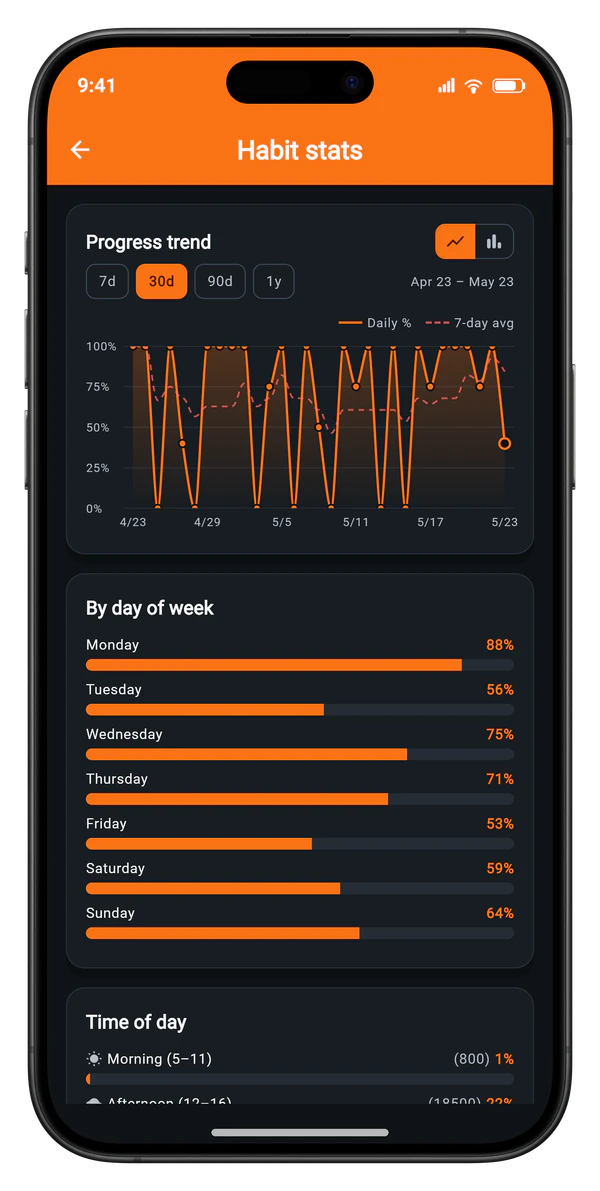
Three numbers that beat one streak
Every per-habit statistic in Habit Tracker is free, so this costs nothing but a minute a month. Open the habit and read three things off the screen.
Completion rate — how many of the planned sessions actually happened. Longest gap — the biggest run of missed planned days, which is the number that predicts abandonment. Return speed — how quickly the next completion came after a miss.
Longest gap predicts abandonment better than streak length
A habit with a 62-day streak that then vanishes for three weeks is more fragile than one that misses a day most weeks and always returns the next morning. The first looks better on a badge. The second is the one that will still exist next spring.
Watch that gap as it grows. Two missed days in a row is ordinary. Five is the point where a habit usually needs a deliberate restart rather than a hopeful Monday.
What the breakdowns are actually for
The day-of-week view answers a question a streak cannot: is it always the same day? Three missed Thursdays in a month is not bad luck, it is a scheduling problem with an obvious fix, and it is worth learning to read the weekday breakdown properly before you change anything.
The time-of-day view usually explains why. A habit logged at 22:30 most evenings does not belong to a 07:00 reminder, and no amount of resolve will fix a reminder that fires nine hours before the behaviour.
Benchmarks add the last bit of context by comparing a habit against your other habits, against its category, or against the previous month. That last comparison is the useful one after a rough few weeks, because it separates “this habit is failing” from “this month was hard”.
A missed day and quitting are different events
A missed day is an event. Quitting is the story you tell about the event.
The recovery rule is short. Do not raise the next target to compensate. Complete the normal version, or the smallest valid version, at the next realistic opportunity. Record the return as part of the habit rather than the start of a new chapter with new rules.
Marek keeps a 34-day meditation streak, misses a Tuesday because of a delayed flight, and deletes the habit on Wednesday to “start clean”. That is the failure — not Tuesday. Tuesday cost him one session out of 35. Wednesday cost him the habit and the history that proved it worked.
If the gap already ran to a week or more, use the comeback plan for a habit you dropped rather than trying to relaunch your best week from memory.
Read the pattern, change one thing
When misses repeat, they usually have a mechanical cause: the reminder arrives during a commute, the habit needs forty minutes on days that have twenty, weekends have no cue, or five habits are competing for the same half hour after work.
Change one part of the system and give it two weeks. Move the cue. Halve the minimum. Prepare the environment the night before. Switch the schedule to match reality — for habits that genuinely do not need to happen daily, a weekly target of three sessions removes the false misses entirely.
One change at a time, because two changes leave you unable to say which one helped.
When a streak is still the right tool
Keep it when the habit really should happen every planned day, the minimum is small and precise, and seeing the count makes starting easier rather than heavier. Medication, daily stretches for an injury, a language app on a 10-minute setting — streaks suit all of these.
Stop looking at it when you notice yourself doing a token version purely to preserve the number, skipping rest you need, quietly lowering the standard after the fact, or treating one miss as proof that the month was wasted. Those are not discipline problems. They are signs the metric is steering the behaviour instead of describing it.
Build something that bends
Real routines pass through illness, travel, deadlines and weeks where nothing goes as planned. A tracking system earns its place by showing what happened without converting normal variation into failure.
Set a clear minimum, review several weeks at a time, and watch how fast you return. Let reminders support that minimum rather than police it, which is the whole point of using reminders without notification fatigue. Keep the streak if you enjoy it — but judge the habit by whether it keeps finding a place in your actual life.