Habit Tracker
Quick answer: share habit progress with one or two people who will notice, not with everyone who might. Send it on a fixed day, once a week, and send a picture of how often the habit happened rather than a streak count. Accountability works when someone expects the update; it backfires when the update becomes the reward.
Telling people about a habit is one of the oldest tricks for keeping it, and one of the easiest to get wrong. Done well, it adds a small, friendly reason to show up on a tired evening. Done badly, it turns a private routine into a performance you have to keep feeding.
The difference is rarely about willpower. It comes down to three choices: who sees it, what they see and when.
Why announcing a habit can make it weaker
A habit announced on day one gets its applause on day one. In a 2009 series of experiments, Peter Gollwitzer and colleagues found that people who announced an identity goal — becoming a lawyer, say — then put less effort into it than people who kept it to themselves. The announcement itself felt like progress.
So hold the news until there is something real to show. Two or three weeks of check-ins is a reasonable point. By then the habit has a shape, and what you share is evidence rather than an intention.
Who to share your progress with
One person who will reply beats two hundred who will scroll past. A partner, a friend who runs, a sibling who is learning the same language: someone who will notice when the Sunday update does not arrive. That is where the accountability comes from, and a group chat of forty rarely provides it.
A partner who shares the habit
This is the strongest set-up, because the update goes both ways. Two people reading twenty pages a night can swap progress every Sunday and both feel the pull of the other one’s grid. It also fails gently: when one of you has a bad week, the other has usually had one too.
Social media and a public audience
Public posts suit the milestone, not the process. A hundredth run or a finished book is worth a story. A daily post about day 23 of anything mostly trains you to expect likes, and the habit starts to feel unfinished until they arrive. If you do post, post rarely and keep the routine itself private.
What to share instead of a streak
A streak is the worst thing to share and the most tempting one. It is fragile in public. Miss one Thursday and the number you have been showing people resets to zero, which is exactly the moment you least want an audience.
Share the activity instead. A grid of the last few weeks shows a routine that holds, gaps included, and a single missed day barely changes how it looks. It is also more honest, which matters if the person on the other end is meant to keep you on track.
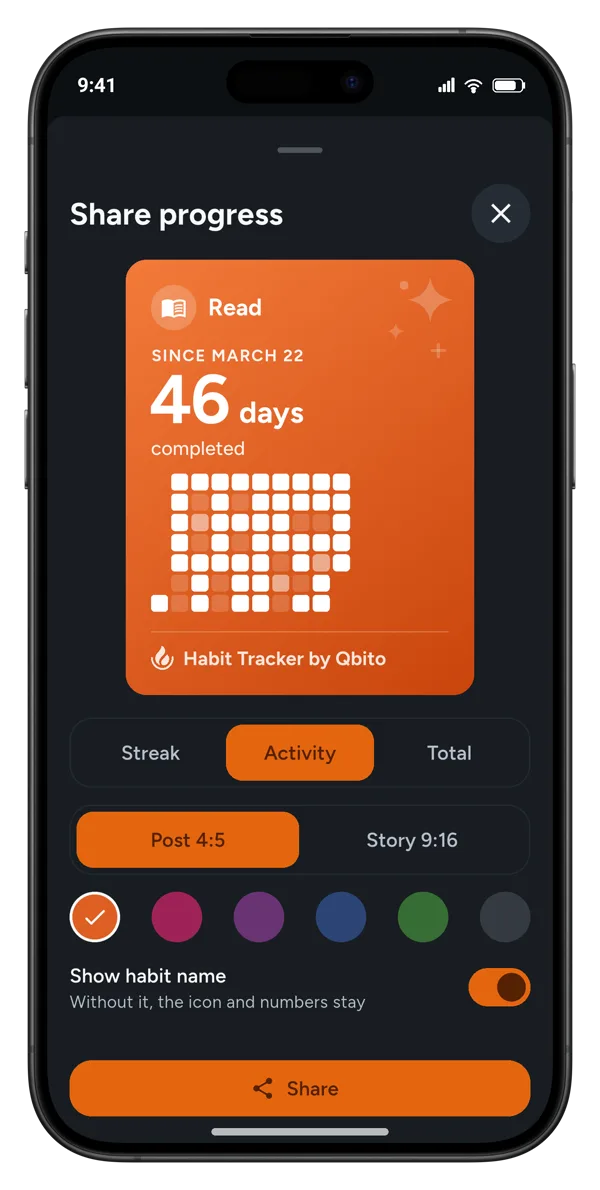
Kasia started reading twenty pages a night on 22 March. By 23 May the habit had a seven-day streak — fine, not impressive — but 46 completed days in nine weeks, roughly three nights in four. A streak card would have said “7”. The activity card said “46 days completed since March 22”, with every gap visible. Same habit, very different story, and the second one is the true one.
When a streak is worth sharing
Streaks still earn a share once they are long enough to mean something: a month of daily stretching for an injury, a hundred days of language practice. At that point the number reflects the habit rather than a lucky fortnight. For habits that run on a weekly target, a streak counts weeks and holds up far better, since one busy day cannot break it.
How often to share habit progress
Once a week, on a fixed day. Sunday evening works for most people: the week is over and the next one has not started. Daily updates are too frequent for anyone else to care about, and monthly ones are too far apart to change anything.
A fixed day also removes a decision. You do not wait for a good week before sharing, which is the habit that quietly kills most accountability set-ups: the updates stop when the progress dips, so nobody notices until it is gone.
Share the bad weeks too
The update that matters most is the one you would rather skip. A week with two check-ins out of seven is precisely when a friend’s “rough one?” helps, and precisely when a silent friend list does not.
Send it anyway, without excuses attached. If the gap has already run past a week, say so and use a plan for restarting after a missed week rather than promising a perfect next one. The person on the other end does not need a recovery speech. They need to know the habit is still alive.
How sharing works in Habit Tracker
Every share card is free. Open a habit’s statistics and tap the share button in the header, or pick Share progress from the habit’s ⋮ menu. The sheet shows a live preview of the card that will be sent.
Three cards are available for a single habit, depending on its history:
- Streak — the current streak from three onwards, or your record with its dates
- Activity — days completed since the habit started, with a grid of up to the last 16 weeks
- Total — everything logged so far, for habits with a unit such as pages or kilometres
From the overall statistics screen you share a summary of the period on screen instead, with your completion rate and no habit names. Each card comes in Post (4:5) or Story (9:16), in one of six colours, and the Show habit name switch keeps the habit private while leaving the icon and numbers. The image goes to the system share window, so it can land in a chat as easily as in a story.
The rest of the numbers behind those cards are on the habit statistics page, and most of them are free too.
Keep the audience small and the habit yours
Accountability can support a habit; it cannot be the reason for it. The habit has to be worth doing on a week when nobody asks about it, otherwise the first quiet Sunday ends it.
Pick one person, one day and one card that shows how often the habit happens. Keep sharing through the bad weeks. And if you notice yourself checking in mainly so the update looks good, step back to tracking without obsessing over streaks — the audience has started steering the habit, and it should be the other way round.