Habit Tracker
Quick answer: to track habits while travelling, keep one portable habit with a small target, skip an exceptional disrupted day, and pause habits that need your home setup. Set a return date before leaving. A planned pause keeps your history; it does not require ticking off actions you never did.
A trip removes the cues that usually carry a routine: the desk, the commute, the book beside the bed. Trying to reproduce your whole weekday somewhere else can turn a holiday into administration. Choose less.
In Habit Tracker, an active habit, a skipped day and a paused habit mean different things. Using those states deliberately gives you a record you can still understand after the suitcase is unpacked.
Decide how to track habits while travelling before you pack
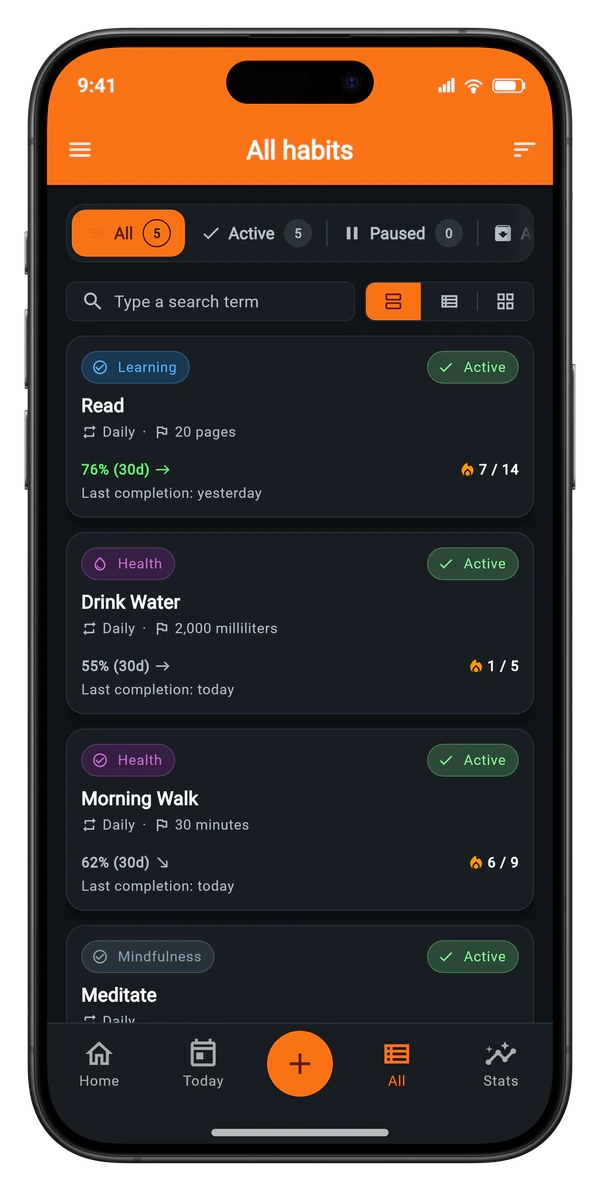
Open All habits and read the names as commitments for the trip. Reading might fit a train journey; writing at a particular desk might have no sensible equivalent. Keep the first and pause the second. The All, Active and Paused filters make that separation visible without deleting anything.
My recommendation is one portable habit for a short trip. Two at most. Keeping five active because five worked at home asks an unfamiliar day to support the same routine without its usual cues. You can still do extra things; they do not all need a daily obligation attached.
Give the habit you keep a smaller finish line
Pick an action that needs little equipment and has a clear end. Five pages after breakfast travels better than half an hour in your usual chair. Set the smaller number in the Goal section before leaving, and log what actually happens. Five means five.
The target value remains editable after entries exist, so a reading target can move from twenty pages to five without creating another habit. Its rhythm is different: once there are logs, that control is locked. A short trip is a poor reason to rebuild the schedule and split your history across two records.
Keep the cue portable too. Breakfast is an event; 07:00 is only a time. The five-page reading plan works well here because the baseline leaves room for days spent elsewhere.
When to skip one day and when to pause
These controls solve different problems. Decide by the length of the interruption, and by whether you still expect the habit to happen.
Skip a single day with no realistic opening
A travel day can be the exception. For a daily habit, open that day’s habit details and use the skip action in the ⋮ menu. A skipped day shows a dash, does not break or extend the streak, and is excluded from the completion percentage. Its reminders are cancelled for that day.
There are limits. Skipping applies to planned days on daily, selected-weekday and every-X-days habits, within the seven-day editing window. It does not apply to weekly or monthly targets, or to Limit habits. A weekly goal has a whole period to work with, rather than a particular Tuesday to excuse.
Do not turn every ordinary miss into a skip. If the reading was possible and you chose something else, leave the gap. That is useful information for the next trip.
Pause a habit that cannot travel with you
Use Pause from the habit’s action menu when the setup will be absent for several days. The dialogue offers an indefinite pause, one week, two weeks, one month or a custom return date, with an optional reason. Write something concrete: “Away from my writing desk.” Future you gets context.
A paused habit keeps its history and stops its reminders. Its inactive days are excluded from the plan rather than becoming missed completions. The return date is the first active day, so choose the first day you can actually do the habit, even if that is the morning after arriving home.
Check the active list on return. Automatic resumption respects the Free plan’s limit of 5 active habits; filling the freed space with new ones can leave the old habit paused. Open its details to resume it and, if necessary, choose another habit to pause.
A five-day trip with an honest record
Consider Nora on an illustrative Monday-to-Friday trip. She pauses daily desk writing before leaving and sets Saturday as the return date. Reading stays active at five pages. Monday is spent in transit, so she skips that day; on Tuesday and Thursday she reads five pages each. The other two days remain uncompleted.
The record is modest. Ten pages read, one explicit exception, two misses, and five planned days away from writing. If writing had a twelve-day streak before the pause, Saturday’s completion takes it to thirteen, rather than counting the holiday as five writing sessions.
Nora also moves the reading reminder to a time she can use at the accommodation. One adjustment is enough. The guide to reminders without notification fatigue explains how to choose that moment without adding alerts throughout the day.
Resume once, then review what travelled well
On the first workable day home, open Paused, check the habit’s details and resume it if needed. Do one ordinary session. There is no catch-up target for the days you deliberately took out of the plan; the restart guide helps if the return itself keeps slipping.
Read your habit statistics with that context. A completion rate excludes excused days, so pair it with the history: a tidy percentage after a pause does not mean you practised throughout the trip. The useful question is which small action survived a different setting.
Keep that answer for next time. Restore a larger target only when it fits the days ahead, and leave the history intact. Before your next departure, you will already know which habit belongs in the suitcase.